The Dominion Group logo

Reference case study

The Dominion Group

Building an AI-enabled company.

Xandec worked across The Dominion Group, from financial services to property operations, to turn AI from a leadership priority into production systems and employee workflows.

Deployment scope

2

Business lines

10+

Portals unified

1,000+

Units managed, supplied figure

Portfolio figure supplied for this case study. Final publication should reconcile units managed with the broader Helm property registry.

Follow the deployment
01

The starting point

The goal was bigger than fixing one workflow.

The Dominion Group wanted to become an AI-enabled operating company. That meant finding where work slowed down across both business lines, building reliable data foundations, shipping useful systems, and teaching people how to use AI inside the work they already owned.

Dominion Financial Services

Manual lending operations slowed decisions.

Staff verified borrowers, reviewed mortgage information, collected documents, calculated DSCR loans, priced deals, and moved cases through portal workflows with too many manual steps.

The issue was not one missing screen. It was the cumulative delay created by repeated checks, handoffs, and systems that did not give borrowers or staff a clear path through the process.

Dominion property operations

The property lifecycle crossed systems and teams.

AppFolio ran day-to-day property management. Buildertrend ran construction. Podio held acquisition, renovation, leasing, and compliance records. QuickBooks supported accounting. Teams maintained mirrors and reconciled handoffs by hand.

Every property moved through acquisition, renovation, leasing, active rental, and turnover. A missing or stale record could hide delay, create duplicate entry, or route a decision using the wrong owner or status.

02

Business line one: financial services

We rebuilt the path from borrower interest to a workable loan.

The financial services work focused on the places where manual verification, calculations, document movement, and limited portal experiences added friction. Each product removed a specific part of that burden while preserving human review where it mattered.

01

Instant Pricing

View live surface

Operational problem

Pricing a loan required staff to collect deal inputs, check program rules, and calculate terms before a borrower could get an answer.

What changed

A live pricing workflow turns structured deal inputs into an immediate pricing path for borrowers and the team.

The workflow organizes property, borrower, loan-purpose, leverage, and pricing inputs before a team member reviews the proposed terms.
02

Borrower portal

Operational problem

Identity checks, mortgage verification, borrower documents, and DSCR loan calculations moved through manual handoffs and disconnected records.

What changed

The borrower portal creates one guided intake and verification surface for the lending workflow.

The review path covers borrower identity, entity information, property details, mortgage information, and supporting documents before underwriting review.

03

Client portal

View live surface

Operational problem

Legacy portal workflows, including LoanPASS, slowed document exchange and made status harder for clients and staff to follow.

What changed

The client portal gives customers a clearer place to submit information, track progress, and continue the process.

The new experience is designed around clear requests, visible progress, and fewer off-platform document and status handoffs.

04

Platform status

View live surface

Operational problem

As the number of production portals grew, employees and customers needed one place to confirm whether each service was available and healthy.

What changed

A public status surface monitors the pricing, borrower, and client portals and makes current service health visible without a support request.

The status layer turns portal health into a shared operational signal and gives the team a clear place to communicate service availability.

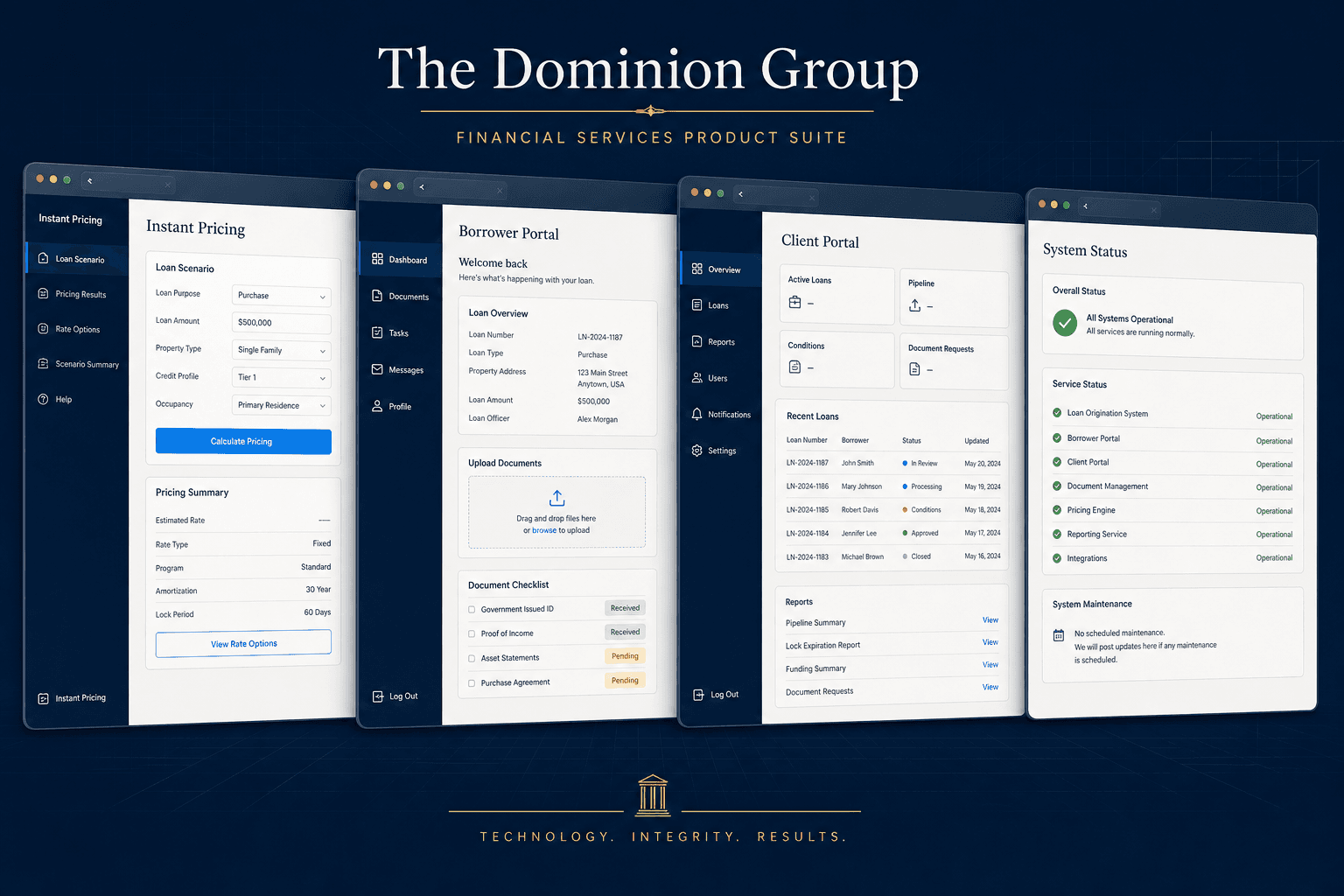
Financial services product suite
Generated concept
Concept composite of Instant Pricing, borrower portal, client portal, and system status interfaces
03

Business line two: property operations

We modeled the business before we automated it.

Property operations were not a linear software problem. A property crosses legal entities, departments, and systems from contract through renovation, leasing, active rental, and turnover. We documented that lifecycle, the people responsible for each transition, and the source of truth at each stage.

The operating principle

Every day a property is owned but not rented carries a cost.

Helm uses one lifecycle model to show where those days accumulate. Phase clocks locate delay. Cross-system rules expose the records that make the lifecycle unreliable.

  1. 01Acquisition and closing
  2. 02Renovation
  3. 03Ready to lease
  4. 04Marketing and application
  5. 05Active rental
  6. 06Notice and turnover
04

The foundation: Helm

Four operating systems became one property-level view.

Helm consolidates the signals needed to understand a property across its lifecycle. PostgreSQL provides the shared data foundation. The pipeline reconciles identifiers, derives lifecycle phases, and applies audit rules across operational records. Claude supports extraction and classification where the source material is unstructured.

Property operations architecture

Operational sources stay accountable for their part of the lifecycle. Helm creates the shared view across them.

S1

AppFolio

Property management

S2

Podio

Acquisition and compliance

S3

Buildertrend

Construction

S4

QuickBooks

Accounting context

Ingest and reconcile

Shared foundation

PostgreSQL property spine

Normalized properties, units, owners, jobs, source evidence, and lifecycle snapshots.

Claude-assisted pipeline

Structure what rules cannot read

Extraction and classification for maintenance notes, scopes, invoices, and other operational text that arrives without a reliable schema.

Resolve into operating views
O1Property registry
O2Lifecycle phases
O3Cross-system audit
O4Role-based workflows

Unified registry

One property spine across systems, owners, units, jobs, and lifecycle evidence.

Lifecycle intelligence

A phase model locates every property and exposes stalled or incomplete handoffs.

Audit layer

Rules flag owner, status, rent, licensing, certificate, and turnover discrepancies for review.

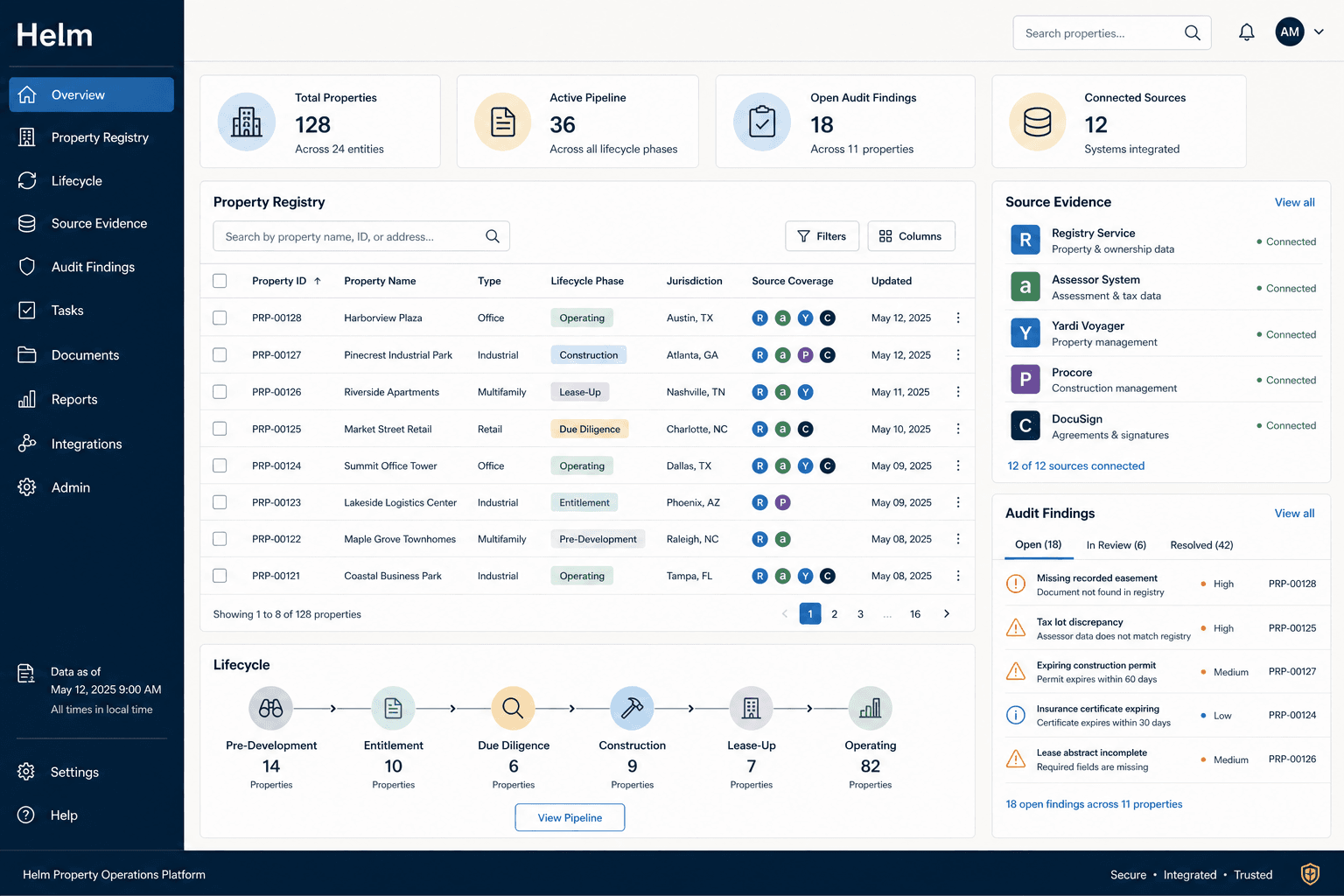
Helm operating view
Generated concept
Concept dashboard for Helm showing a property registry, lifecycle phases, connected sources, and audit findings
05

AI in the hands of employees

The deployment changed individual work, role by role.

Production systems created leverage at the company level. Adoption required a second layer: putting AI into the daily work of the people who price loans, review documents, lease units, run construction, reconcile records, and manage compliance.

01

Lending and underwriting

Before

Manual verification, document review, pricing, and DSCR calculations across several steps.

With the deployment

AI-assisted workflows inside pricing, borrower intake, and internal review.

AI prepares and structures the work. Lending staff retain responsibility for verification, exceptions, and final decisions.

02

Leasing and property operations

Before

AppFolio held the live leasing workflow while staff and assistants mirrored status into Podio.

With the deployment

Helm creates a shared property view and exposes lifecycle exceptions without another manual lookup.

A leasing or operations user can review one property record with source evidence and exceptions instead of rebuilding context across platforms.

03

Construction

Before

Project managers worked in Buildertrend while administrators maintained a separate Podio renovation mirror.

With the deployment

The unified layer connects construction status to the property lifecycle and the handoff back to leasing.

Construction status and handoff evidence are normalized so project and property teams can identify missing steps before they become hidden delays.

04

Accounting and compliance

Before

Teams cross-checked owner entities, rent, licenses, certificates, invoices, and operational records by hand.

With the deployment

Cross-system audit rules surface mismatches and expiring records in one place for review.

The system structures supporting records and directs mismatches to a human reviewer rather than making autonomous accounting or compliance decisions.

06

Forward deployed engineering and GTM

We worked inside the company, then built systems for operations and growth.

This engagement combined two kinds of deployment. Forward deployed engineering embedded technical builders inside the organization to understand and improve how work moved. The GTM track applied the same systems approach to finding, enriching, and qualifying new leads.

FDE

Forward deployed engineering

Engineers embedded across the operating company.

As forward deployed engineers, we did more than take software requirements. We worked alongside lending, leasing, construction, property operations, and accounting to understand the decisions, handoffs, records, and exceptions that shaped daily work.

Map

Documented business lines, roles, systems of record, and property lifecycle handoffs.

Build

Connected fragmented data and shipped production tools around real employee workflows.

Deploy

Put AI into the work itself, with domain owners involved in testing and review.

Train

Developed the playbook for training FDEs and enabling employees to continue using AI effectively.

A representative FDE workflow connected property source data, lifecycle evidence, and audit exceptions so operations staff could investigate a property without rebuilding its history by hand.

FDE deployment architectureEmbedded delivery loop

Embedded business functions

Lending
Leasing
Property
Construction
Accounting
Observe decisions, data, and exceptions

01 Map

Operating context

Roles, ownership, handoffs, approval boundaries, and daily workflows.

model

02 Foundation

HubSync + PostgreSQL + Claude

Normalize system records and structure operational text into shared context.

build

03 Surfaces

Portals, Helm, and automation

Deploy production tools into the workflows employees already own.

Deploy, review, train, improve

AI inside employee workflows

Employees use structured context, AI assistance, and visible exceptions with human decision ownership preserved.

Transfer capability
GTM

Go-to-market engineering

A lead waterfall built for the leasing motion.

For the leasing GTM workflow, we built a waterfall model that sources potential leads from CoStar, then passes each record through multiple research, extraction, and enrichment services before it reaches the team.

GTM lead waterfall architectureSource to leasing team

Source 01

CoStar

Commercial property and market lead universe.

Source 02

DataTree

Property, ownership, and public-record context.

Source 03

Claude research

Generate and expand target candidates from defined criteria.

Enter waterfall

01 Research

Perplexity

Verify company, property, and market context against current sources.

02 Extract

Apify + APIs

Collect websites, contact data, and supporting public evidence.

03 Resolve

Clean and deduplicate

Normalize records, remove weak matches, and resolve duplicate entities.

04 Qualify

Score and route

Apply leasing criteria and send qualified records to the correct motion.

Activate qualified lead

Destination

Leasing team

Review qualified accounts with source evidence attached.

Communication

Twilio + RingCentral

Support structured calling, messaging, and follow-up workflows.

Learning loop

Disposition feedback

Return outcomes to targeting and scoring criteria for the next run.

CoStar provides the starting universe. Claude and Perplexity support research and qualification. Apify and additional public-record and contact-enrichment services collect and normalize the evidence used to clean each lead.

The model

The same delivery discipline connected both tracks: understand the operating context, build against real constraints, deploy with the people doing the work, and leave behind a capability that can be repeated.

08

Why Claude

A practical choice for the work.

  • Claude handled messy operational text more reliably than the alternatives benchmarked for the deployment.
  • Anthropic's safety and enterprise posture mattered because workflows touched tenant and borrower financial records.
  • Token-cost optimization kept extraction and classification economically viable at portfolio scale.
09

Technical stack

Systems connected around the work.

AI and data

ClaudePostgreSQLFastAPIPerplexity

Products

HelmHubSyncInstant PricingLoanPASS

Business systems

AppFolioPodioBuildertrendQuickBooksSage

GTM and communications

CoStarDataTreeApifyTwilioRingCentral

Engineering

ReactNext.jsNestJSViteRedux ToolkitPlaywrightDockerTraefik

Helm is the property operations product. HubSync is the synchronization and normalization layer supporting its shared property view. LoanPASS remains part of the financial-services system landscape while the newer pricing and portal surfaces improve the borrower and client experience around it.

10

Deployment scale

A program spanning systems, products, and business lines.

These figures describe the documented scope of the deployment. Performance outcomes such as hours saved, conversion lift, and cycle-time reduction should be added only after Dominion validates the measurement.

2

Business lines

Financial services and property operations

10+

Portals unified

Customer and internal operating surfaces

5+

Customer surfaces

Pricing, borrower, client, status, and supporting experiences

1,000+

Units managed

Residential rental portfolio

Build the next deployment

Start with the company, then build the AI around its work.